
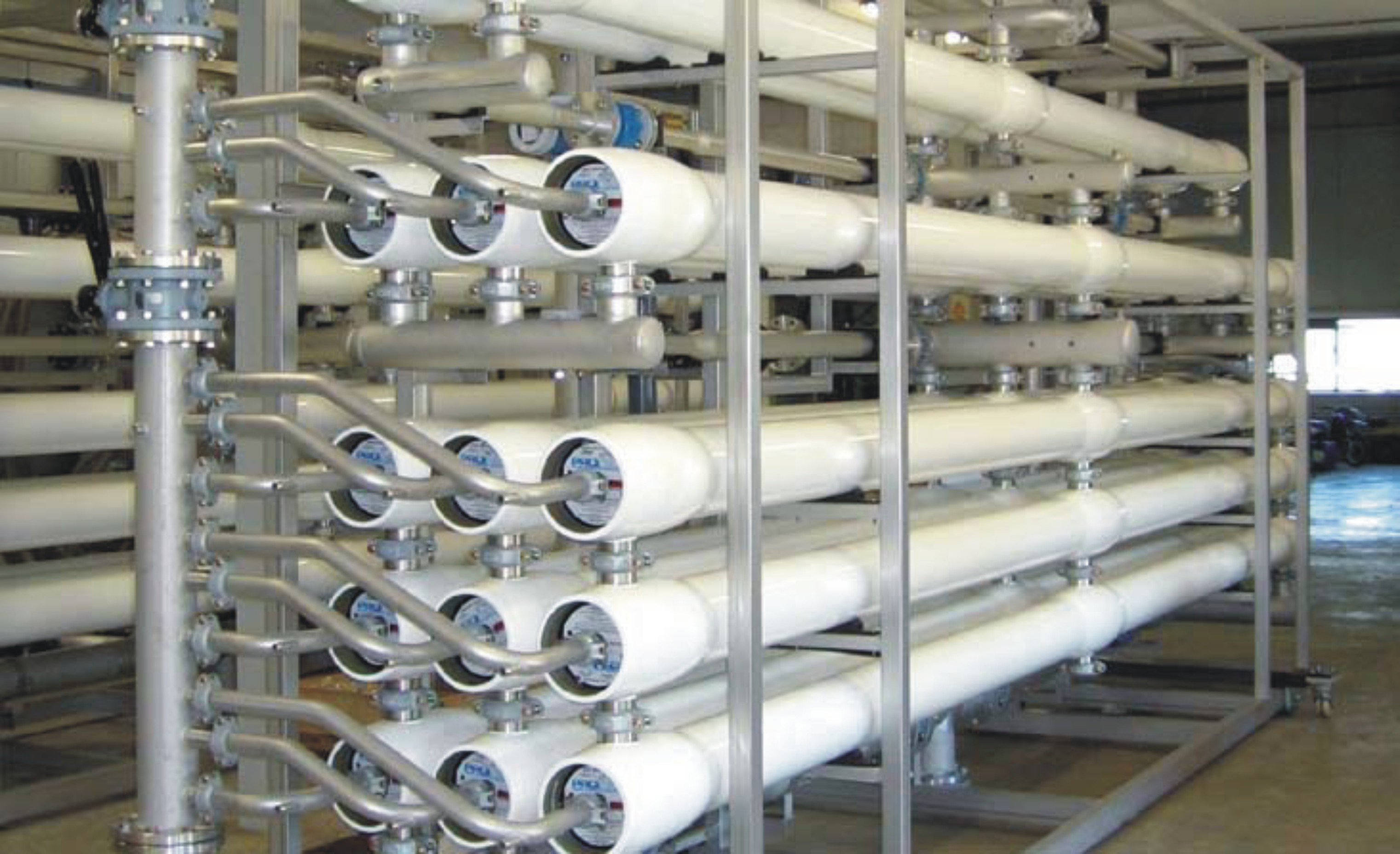
The RO pressure vessel is the unglamorous but critical component that holds your membrane elements and contains the operating pressure of the system. Get the selection right and it will run reliably for 15-20 years. Get it wrong - an under-rated vessel on seawater duty, the wrong port configuration for your array, or an element count that unbalances the hydraulics - and you risk membrane damage, leaks, and costly re-engineering.
This guide walks through the six decisions that determine which FRP pressure vessel is right for your plant: element size, port configuration, pressure rating, element count, material and certification, and installation planning - with regional notes for engineers in India, the Middle East, Africa, and worldwide.
Step 1: Match the Vessel to Your Element Size
The vessel bore must match the diameter of your RO membrane elements. There are three standard industrial sizes:
| Vessel Size | Houses | Typical System Flow | Common Applications |
|---|---|---|---|
| 4-inch | 4" × 40" elements | Up to 10-20 m³/hr | Commercial, hospitals, hotels, small industrial, F&B |
| 8-inch | 8" × 40" elements | 20 m³/hr and above | Industrial, municipal, desalination, boiler feed |
| 16-inch | 16" large-diameter elements | Very high capacity | Large municipal & desalination megaprojects |
Rule of thumb: For large plants, choose the largest practical vessel size. An 8-inch or 16-inch array needs far fewer vessels, end connections and interconnecting pipework than the equivalent flow built from 4-inch vessels - which reduces both installed cost and the number of potential leak points.
Step 2: Side-Port vs End-Port Configuration
Once the size is fixed, the port configuration determines how the vessel connects to the rest of the array. This is one of the most commonly misunderstood specifications.
End-Port Vessels
Feed and concentrate connections are on the end caps (heads). Simplest layout for a single vessel or a short series string. Common on 4-inch systems and small skids where only one or two vessels are used.
Side-Port Vessels
Feed, permeate and concentrate ports are located on the sides near each end of the vessel. This lets multiple vessels be manifolded together in parallel with clean, straight header piping - the standard approach for multi-vessel 8-inch industrial and desalination arrays. Side-port vessels simplify manifolding, reduce pipe stress, and make element loading and servicing easier.
Common mistake: Ordering end-port vessels for a large parallel array. It forces awkward, stress-prone piping and complicates maintenance. For any array of three or more 8-inch vessels running in parallel, specify side-port.
Step 3: Specify the Correct Pressure Rating
The vessel's design pressure must comfortably exceed your maximum operating pressure. Under-rating is dangerous; the operating pressure depends entirely on whether you are treating brackish or seawater.
| Duty | Operating Pressure | Recommended Vessel Rating | Vessel Type |
|---|---|---|---|
| Brackish water RO (BWRO) | 10-20 bar | 300 psi (21 bar) | Standard FRP |
| High-recovery / higher-pressure BWRO | up to 30 bar | 450 psi (31 bar) | FRP |
| Seawater RO (SWRO) | 55-70 bar | 1000 psi (69 bar) | Composite / high-pressure FRP |
Rule of thumb for the Gulf & coastal Africa: Seawater desalination in the UAE, Saudi Arabia, Oman, Qatar and coastal West Africa runs at 55-70 bar. Never use a 300 psi BWRO vessel on this duty - specify a 1000 psi composite pressure vessel rated for SWRO. Pair it with high-rejection seawater RO membranes and seawater antiscalant.
Step 4: Choose the Element Count per Vessel
Vessels are available to hold from 1 to 8 elements in series. The element count shapes your array layout and hydraulics:
- 1-3 element vessels: Small commercial and pilot systems, or the tail end of a multi-stage array.
- 6-element vessels: The most common choice for large industrial and desalination arrays - a good balance of footprint, cost and hydraulic performance.
- 7-8 element vessels: Maximise elements per vessel to minimise vessel count and footprint, but increase feed-to-concentrate pressure drop and require careful flux balancing.
Design tip: More elements per vessel means fewer vessels and connections, but higher pressure drop across the vessel and greater flux imbalance between the lead and tail elements. Your RO array (e.g. a 2:1 array of 6-element vessels) should be designed so no single element exceeds its maximum recovery or minimum concentrate flow limits.
Step 5: Material and Certification
Standard RO vessels are filament-wound FRP (fibreglass-reinforced plastic) - corrosion-proof, lightweight and cost-effective. For the highest pressures (SWRO), composite construction is used. Key specifications to confirm:
- NSF/ANSI 61 certification - required where the permeate is destined for drinking water contact.
- ASME-code design - vessels designed and rated to recognised pressure-vessel code for safety and insurability.
- Temperature rating - confirm the vessel is rated for your maximum feed temperature (important in the Gulf, where seawater can exceed 35°C).
- End closure / head type - segmented retaining ring closures are standard; confirm they suit your maintenance access.
Step 6: Plan for Installation and Maintenance
A correctly specified vessel still needs correct installation to reach its service life:
- Thrust support: Vessels must be mounted so that hydraulic thrust is transferred to the frame, not the piping. Use the manufacturer's saddle and thrust-ring arrangement.
- Loading orientation: Load elements in the direction of feed flow and confirm brine seals face the correct way - a reversed seal causes bypass and poor rejection.
- Never pressurise a partially loaded vessel: Always fill with the full element count (or approved fillers) before pressurising.
- Allow service clearance: Leave axial clearance at one end for element removal - critical for 6-8 element vessels.
FRP Pressure Vessel Selection - Quick Reference
| Application | Vessel Size | Port Type | Pressure Rating |
|---|---|---|---|
| Small commercial / institutional BWRO | 4-inch | End-port | 300 psi |
| Industrial BWRO array (India / GCC inland) | 8-inch | Side-port | 300-450 psi |
| Seawater desalination (Gulf / coastal Africa) | 8-inch | Side-port | 1000 psi composite |
| Large municipal / megaproject | 16-inch | Side-port | per design duty |
How to Get a Pressure Vessel Quotation from Genoasis
To receive an accurate quotation, send us the following:
- Element size (4", 8" or 16") and number of elements per vessel
- Maximum operating pressure (or your feed water type: brackish or seawater)
- Port configuration required (side-port or end-port)
- Number of vessels / array configuration
- Any certification requirement (NSF/ANSI 61, ASME)
- Delivery country and port for freight estimation
We supply FRP and composite RO pressure vessels to projects across India (Chennai, Mumbai, Delhi, Bangalore, Hyderabad), the Middle East (UAE, Saudi Arabia, Qatar, Kuwait, Oman, Bahrain), Africa (Nigeria, Kenya, South Africa, Ghana), and worldwide. Browse our FRP pressure vessel range or contact our technical team for a prompt quotation and selection recommendation.
Frequently Asked Questions
What is the difference between a side-port and end-port RO pressure vessel?
In an end-port vessel, feed and concentrate connections are on the end caps and vessels are plumbed in series through the heads - simplest for small single-vessel systems. In a side-port vessel, the feed, permeate and concentrate ports are on the sides near each end, letting multiple vessels be manifolded in parallel with cleaner piping. Side-port is standard for multi-vessel 8-inch industrial arrays; end-port suits 4-inch and small systems.
How do I choose between a 4-inch, 8-inch and 16-inch pressure vessel?
Match the vessel to your membrane element diameter and total flow. 4-inch vessels suit systems up to about 10-20 m³/hr; 8-inch is the industrial workhorse for 20 m³/hr and above; 16-inch houses large-diameter elements for very high-capacity municipal and desalination plants. Choose the largest practical size for large plants to cut piping and installation cost.
What pressure rating do I need for my RO pressure vessel?
For brackish water RO, 300 psi (21 bar) FRP vessels are standard, with 450 psi for high-recovery designs. For seawater RO desalination at 55-70 bar, you need 1000 psi (69 bar) composite or high-pressure FRP vessels. Always specify a comfortable margin above maximum operating pressure and never run a 300 psi vessel on seawater duty.
How many membrane elements fit in one pressure vessel?
Standard vessels hold 1 to 8 elements in series, with 6-element vessels most common in large industrial and desalination arrays. More elements per vessel reduces vessel count, connections and footprint, but increases pressure drop through the vessel and requires careful hydraulic and flux-balance design across the array.
Are Genoasis FRP pressure vessels certified?
Yes. We supply FRP and composite RO pressure vessels made to international standards, including NSF/ANSI 61 certification for drinking water contact and ASME-code design pressure ratings. Full documentation - test certificates, pressure ratings and material specifications - is provided with every order. Contact us with your element size, element count and operating pressure for a certified vessel recommendation.