
Choosing the wrong RO membrane is one of the most common and costly mistakes in water treatment system design. Use a brackish water membrane where seawater is the feed source, and you will irreversibly damage the element within days. Use a seawater membrane on borewell water, and you'll waste significant energy and capital every year the plant operates.
This guide walks through the key selection parameters - membrane type, element size, salt rejection specification, and regional application considerations - so that engineers and procurement teams worldwide - with detailed guidance for India, the UAE, the Middle East, Africa, and global applications - can make the right call the first time.
Step 1: Identify Your Membrane Type
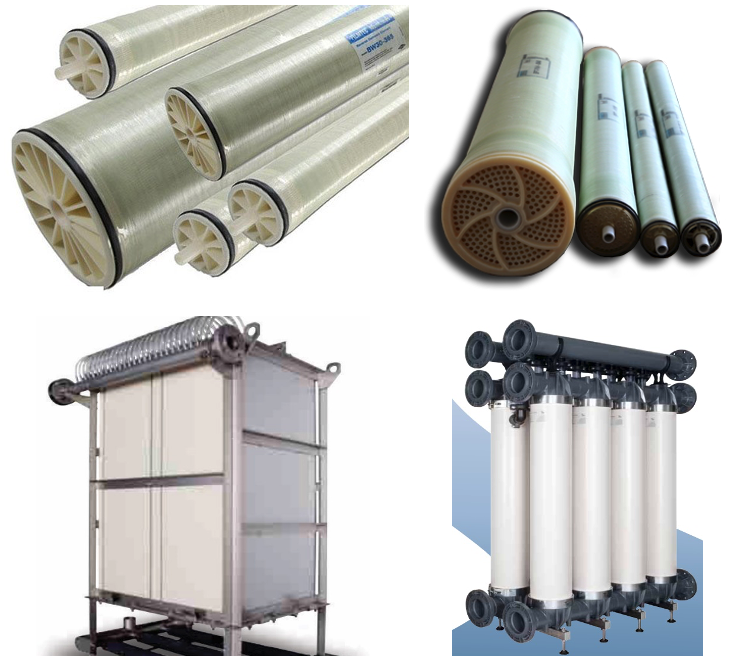
The starting point for membrane selection is always the feed water source and the target permeate quality. There are five main membrane technologies to consider:
| Membrane Type | Feed TDS Range | Typical Operating Pressure | Primary Use |
|---|---|---|---|
| BWRO (Brackish Water RO) | 500 – 10,000 ppm | 10 – 20 bar | Borewell, river, tap water treatment |
| SWRO (Seawater RO) | 10,000 – 45,000 ppm | 55 – 70 bar | Seawater desalination |
| NF (Nanofiltration) | 200 – 2,000 ppm | 5 – 10 bar | Hardness removal, colour removal, partial softening |
| UF (Ultrafiltration) | Any (turbidity/particle based) | 1 – 3 bar | Pre-treatment before RO, turbidity removal, pathogen rejection |
| MBR (Membrane Bioreactor) | Biological wastewater | 0.1 – 0.5 bar (suction) | Wastewater treatment and reuse |
Rule of thumb for India: If your feed water is groundwater (borewell) with TDS between 1,000 and 8,000 ppm - which describes most of Tamil Nadu, Rajasthan, Gujarat, and Andhra Pradesh - you need a BWRO membrane. Never use an SWRO element here; it will technically work but will consume 3–4x the energy for no quality benefit.
Rule of thumb for the UAE and Gulf: If you are treating seawater from the Arabian Gulf or Red Sea (TDS typically 42,000–45,000 ppm), you need a high-rejection SWRO membrane rated for that salinity range. For inland borewell sources in the UAE or Saudi Arabia (brackish, 2,000–8,000 ppm TDS), a BWRO membrane is the correct and more energy-efficient choice.
Rule of thumb for Africa: Feed water quality varies significantly by region. Coastal cities in Nigeria, Kenya, Ghana, and Tanzania often have access to high-salinity sources requiring SWRO, while inland areas such as Nairobi, Lagos (inland zones), Addis Ababa, and Johannesburg typically rely on surface water or groundwater suited to BWRO or NF treatment. Always test your feed water before specifying membranes.
Rule of thumb for Southeast Asia: Feed water in Malaysia, the Philippines, Indonesia, and Thailand is typically low-TDS surface water (100–500 ppm) with high turbidity and biofouling risk. UF pre-treatment followed by a low-fouling BWRO membrane is the standard configuration. Focus on fouling-resistant membrane surfaces over maximum salt rejection for these applications.
Rule of thumb for Europe, UK, and Australia: Hard municipal or brackish groundwater (TDS 300–800 ppm in Europe; 2,000–8,000 ppm in parts of Australia) calls for a standard or low-energy BWRO membrane. Coastal Australian desalination plants use the same SWRO membranes as Gulf plants. European industrial applications increasingly favour low-pressure, energy-efficient BWRO elements to reduce operating costs.
Rule of thumb for the Americas: Groundwater in the southwestern USA, northern Mexico, Chile, and Argentina often carries high sulphate and TDS similar to Indian borewell conditions - high-rejection BWRO is appropriate. For ultra-pure water in semiconductor or pharmaceutical applications, specify the highest-rejection elements available (99.7%+ BWRO). Municipal surface water applications across North America typically use low-pressure BWRO for energy efficiency.
Step 2: Select Element Size - 4-inch vs 8-inch
Once you know your membrane type, the next decision is element size. Standard spiral-wound elements come in two main configurations for industrial use:
4-inch Elements (4" × 40")
Suitable for systems producing up to 10–20 m³/hr permeate. These are the workhorse of commercial and small industrial plants - beverage companies, hospitals, hotels, small municipal treatment facilities, and laboratory water systems. They are generally more affordable per element but require more pressure vessels for higher flow rates.
8-inch Elements (8" × 40")
Suited to systems producing 20 m³/hr and above. Industrial plants, large-scale SWRO desalination, municipal water treatment, and power plant boiler feed water systems all typically use 8-inch elements. Fewer pressure vessels are needed for the same output, reducing piping and installation costs - but each element and vessel costs more than its 4-inch counterpart.
2.5-inch Elements
Used in small point-of-use, laboratory, and pilot-scale systems producing a few hundred litres per hour. Also useful for sampling and water analysis purposes.
Step 3: Specify the Right Salt Rejection Rate
Salt rejection is the percentage of dissolved solids that the membrane removes from the feed water. It is measured at standard test conditions (typically 2,000 ppm NaCl, 15.5 bar, 25°C, 15% recovery for BWRO).
- BWRO standard: Specify a minimum stabilised salt rejection of 99.5%. High-rejection BWRO elements achieve 99.7%+ and are preferred where permeate quality is critical (pharmaceutical, beverage, ultra-pure water).
- SWRO standard: Specify a minimum of 99.7% to achieve potable-quality permeate from seawater. Some premium SWRO elements achieve 99.8% rejection.
- Low-energy elements: These sacrifice a small amount of rejection (typically 99.0–99.3%) in exchange for significantly lower operating pressure, making them attractive for energy-cost reduction in large plants where permeate quality targets allow it.
Step 4: Consider Climate and Application-Specific Factors
High-temperature feed water (UAE, Saudi Arabia, GCC)
Gulf seawater temperatures can reach 35°C+ in summer. At higher temperatures, membrane flux increases and salt rejection decreases. Specify elements rated for your maximum expected feed water temperature. SWRO membranes for Gulf applications should also resist chloride stress-corrosion and biofouling from the high-organic-content Gulf seawater.
High-silica borewell water (India)
Borewell water in Tamil Nadu, Maharashtra, Rajasthan, and Andhra Pradesh often contains elevated silica (50–100 ppm+). Silica is one of the trickiest scalants to control - it polymerises on membrane surfaces irreversibly if the Langelier Saturation Index is not carefully managed. Specify a membrane with good silica rejection (>97%) and always pair with an antiscalant specifically formulated for silica control.
High-turbidity surface water (Africa)
Many African water treatment projects rely on river or lake water (Niger River basin, Lake Victoria catchment, Nile Basin) which can carry high suspended solids and turbidity loads, especially seasonally. These feed waters require robust pre-treatment - coagulation, sedimentation, and multi-media filtration - before RO. Consider UF pre-treatment to achieve an SDI (Silt Density Index) below 3 before the RO stage. Choosing a membrane with a fouling-resistant surface coating extends cleaning intervals significantly in these conditions.
Fluoride contamination (East Africa, parts of India)
Parts of Kenya, Ethiopia, and Tanzania - particularly the East African Rift Valley - have groundwater with fluoride concentrations of 5–30 ppm, far above the WHO guideline of 1.5 mg/L. Standard BWRO membranes reject 95–98% of fluoride, making RO one of the most effective defluoridation technologies. Nanofiltration is less effective for fluoride removal and should not be used as the sole treatment step where fluoride is a primary concern.
Hard municipal feed water (Europe, UK)
European and UK RO systems typically treat hard municipal tap water with TDS of 300–800 ppm. The primary challenge is calcium carbonate scaling. Standard BWRO membranes with 99.5% rejection are widely used; low-energy elements are increasingly common across European industry to reduce electricity costs. In wastewater reuse applications - growing across the EU driven by water scarcity regulation - fouling-resistant membranes with low surface roughness extend cleaning intervals in high-organic feed water conditions.
Brackish groundwater (Australia, southwestern USA, Latin America)
Brackish aquifers in Western Australia, South Australia, the southwestern USA (Arizona, California, Texas), northern Mexico, and parts of Chile carry TDS of 2,000–8,000 ppm with high sulphate and carbonate hardness - very similar to Indian borewell water. The same high-rejection BWRO elements used in India apply here. For drinking water production where permeate quality targets are strict, specify elements with 99.5%+ salt rejection. Coastal Australian desalination plants (Perth, Sydney, Melbourne) use SWRO membranes comparable to Gulf specifications.
Tropical surface water (Southeast Asia)
Water treatment plants across Malaysia, the Philippines, Indonesia, and Thailand primarily process river, reservoir, and lake water with low TDS (100–500 ppm) but challenging biofouling conditions driven by high ambient temperatures and elevated organic load. BWRO membranes with fouling-resistant surface coatings - designed to reduce biofilm adhesion - outperform standard elements in these conditions. UF or dual-media pre-treatment is essential to bring SDI below 3 before the RO stage. Chemical cleaning frequencies are higher than in drier-climate applications, so membranes with good chemical cleaning tolerance (wide pH cleaning range) are preferred.
Step 5: Verify Compatibility with Your Pressure Vessels
RO elements must be compatible with the pressure vessels (housings) in your system. Key compatibility checks:
- Element diameter: 4" or 8" - must match vessel bore
- Element length: Standard is 40" - some vessels accommodate shorter 20" or special-length elements
- O-ring and interconnector specification: Brine seal and interconnector dimensions vary slightly between manufacturers. Confirm compatibility before mixing brands in an existing vessel array
- Maximum operating pressure: FRP vessels are typically rated to 300 psi (21 bar) for BWRO. SWRO service requires composite pressure vessels rated to 600 psi (41 bar)
Step 6: Plan for Membrane Maintenance and Replacement
The best membrane selection is wasted without a proper operational programme. RO membranes typically last 3–5 years under good operating conditions - the key factors that extend or shorten this are:
- Antiscalant dosing: Continuous, correctly-dosed antiscalant prevents carbonate, sulphate, silica, and barium scale from forming on the membrane surface
- Pre-filtration quality: Feed SDI should be below 5 (ideally below 3) to prevent particulate fouling. Use 5-micron and 1-micron cartridge filters upstream of the RO
- CIP cleaning frequency: Clean-in-place with acid and alkaline cleaners when normalised permeate flow drops more than 10–15% from baseline, or normalised salt passage increases more than 10%
- Chlorine elimination: RO polyamide membranes are permanently damaged by free chlorine above 0.1 ppm. Always dose sodium metabisulphite (SMBS) upstream of the RO if chlorine is present in the feed
Membrane Selection by Region - Quick Reference
| Region / Feed Water | Recommended Membrane | Key Challenge |
|---|---|---|
| India - borewell (TDS 1,500–8,000 ppm) | High-rejection BWRO | Silica, hardness, carbonate scaling |
| India - river / surface water | UF pre-treatment + BWRO | Turbidity, seasonal TDS variation, biofouling |
| UAE / GCC - seawater | High-rejection SWRO | High salinity, temperature, biofouling |
| UAE / Gulf - inland borewell | BWRO | Sulphate, carbonate, hardness |
| West Africa (Nigeria, Ghana) - coastal | SWRO or BWRO depending on source | High organics, biofouling, turbidity |
| East Africa (Kenya, Ethiopia) - groundwater | BWRO (often with fluoride removal target) | Fluoride, iron, hardness |
| South Africa - surface water / municipal | NF or BWRO | Seasonal quality variation, organics |
| Tanzania - Lake Victoria catchment | UF pre-treatment + BWRO | High turbidity, organics, biological load |
| UK / Europe – hard municipal (TDS 300–800 ppm) | Low-pressure BWRO | Calcium carbonate, wastewater organics (reuse) |
| Australia – brackish groundwater (WA, SA) | High-rejection BWRO | Sulphate, carbonate, silica |
| Australia – coastal seawater desalination | High-rejection SWRO | Salinity, biofouling, seasonal temperature variation |
| USA / Mexico / Latin America – brackish groundwater | High-rejection BWRO | Sulphate, carbonate, silica (similar to India) |
| Southeast Asia – tropical surface water | UF pre-treatment + low-fouling BWRO | Biofouling, turbidity, high organics |
How to Get a Membrane Quotation from Genoasis
To receive an accurate quotation for RO membrane elements, provide us with the following information:
- Feed water analysis (TDS, pH, hardness, sulphate, silica, iron, chlorine if any)
- Desired permeate flow rate (m³/day or m³/hr)
- Current or planned system recovery rate (%)
- Current membrane brand and model number (for replacement orders)
- Element size (4" or 8") and number of elements per vessel
- Delivery country and port (for freight cost estimation)
We supply membrane elements to projects worldwide - including India (Chennai, Mumbai, Delhi, Bangalore, Hyderabad, Ahmedabad), the Middle East (UAE, Saudi Arabia, Qatar, Kuwait, Oman, Bahrain), Africa (Nigeria, Kenya, South Africa, Ghana, Tanzania, Ethiopia), and global customers in the UK, USA, Australia, Singapore, Malaysia. Contact our technical team with your requirements for a prompt quotation and selection recommendation.
Frequently Asked Questions
What is the difference between BWRO and SWRO membranes?
BWRO (brackish water RO) membranes are designed for feed water TDS up to 10,000 ppm and operate at 10–20 bar. SWRO (seawater RO) membranes handle TDS up to 45,000 ppm at 55–70 bar. Using BWRO membranes on seawater will cause irreversible damage - they cannot withstand the required operating pressure. Using SWRO on brackish water is wasteful but not damaging.
How do I choose between a 4-inch and 8-inch RO element?
4-inch elements are used in systems producing up to 10–20 m³/hr. 8-inch elements are for 20 m³/hr and above. 8-inch systems reduce the number of pressure vessels needed and have lower specific membrane area cost at scale, but each vessel and element costs more up front. For small commercial or institutional plants, 4-inch is generally the right choice.
What salt rejection rate should I specify?
For BWRO, specify a minimum stabilised salt rejection of 99.5%. For SWRO desalination, specify 99.7% or higher. For drinking water or pharmaceutical use, choose high-rejection elements. If energy cost reduction is more important than maximum permeate purity, low-energy elements (99.0–99.3% rejection) may be suitable.
Which RO membrane is best for high-TDS borewell water in India?
For Indian borewell water with TDS of 1,500–8,000 ppm - common across Tamil Nadu, Rajasthan, Gujarat, Andhra Pradesh, and Maharashtra - specify a high-rejection BWRO element (99.5%+ salt rejection). Pair it with a phosphonate or polymer antiscalant to control carbonate, sulphate, and silica scale, and install 5-micron and 1-micron cartridge pre-filters to protect the membrane surface.
Can NF membranes be used instead of RO for water softening?
Yes, in some cases. NF selectively rejects divalent ions (calcium, magnesium, sulphate) at lower pressures than RO, making it energy-efficient for hardness removal and partial softening when full TDS reduction is not required. However, if you need to reduce TDS from 3,000+ ppm to drinking water standards, RO is necessary. NF is not suitable for seawater desalination or high-TDS brackish water.